HINTS Exam
- Used to differentiate central from peripheral etiologies of vertigo.
- First, screen for central features on history. If ANY positive, proceed directly to imaging.
- New significant headache/neck pain
- New focal parasthesias or weakness
- Dangerous Ds: Dysarthria/dysphonia, diplopia, dysphagia, dysmetria
- Unable to walk unaided
- Spontaneous vertical nystagmus
- HINTS cannot be used unless nystagmus is present at time of exam (either at rest or with lateral gaze)
- 3 exams to perform for HINTS. If ANY positive, concerning for central cause, proceed to neuroimaging.

- Direction-changing nystagmus in eccentric gaze: Have patient look to both left and right. Observe the direction of the fast/slow beat of nystagmus.
- Central Finding: Any vertical OR purely torsional/rotary nystagmus OR bidirectional/direction changing nystagmus.
- Bidirectional/direction changing nystagmus: If direction of fast beat of nystagmus changes directions when looking to one side versus the other (ie: left gaze has fast beat towards left but right gaze has fast beat towards right).
- Vertical skew: Have patient focus gaze on your nose. Use your hand to cover to cover one eye (and then the other).
- Central Finding: Vertical deviation of one eye while it is covered, followed by correction when uncovered.
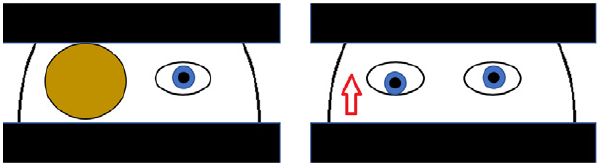
- Central Finding: Vertical deviation of one eye while it is covered, followed by correction when uncovered.
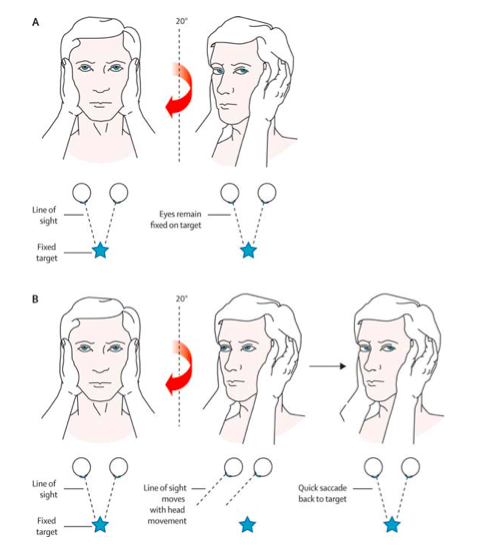
- Head impulse test: Hold the patient's head, allowing their mandible to rest and relax into your palms. Ask the patient to fixate on your nose. Gently move the patient's head to the left or right and then quickly back to the midline position.
- Central Finding: Absence of saccade, in other words, the pts eyes move with the head (no large beats of nystagmus as the eyes "catch up" to re-fixate on examiner's nose)
- The central finding results from disruption to the vestibulo-ocular reflex causing the eyes move with the head.
- Below, Fig A shows a central finding where eyes remain fixed on target with movement of the head. Whereas Fig B shows a peripheral finding where eyes lag initially and then saccade to re-fixate on the nose.
References:
- https://www.youtube.com/watch?v=Vut7rqYyDyk
- https://www.emra.org/emresident/article/hints-exam/
- https://www.nuemblog.com/blog/hints
- https://geekymedics.com/the-head-impulse-nystagmus-test-of-skew-hints-examination/
Created on: Sunday 08-13-2023