Scrub typhus
Presentation :
- Scrub typhus is endemic in an area of Asia-Pacific bounded by Japan, Korea, China, India, and northern Australia.
- After an incubation period of 6-21 days (mean 10-12 days), symptoms of scrub typhus start suddenly and include: Fever, chills, headache, and generalized lymphadenopathy.
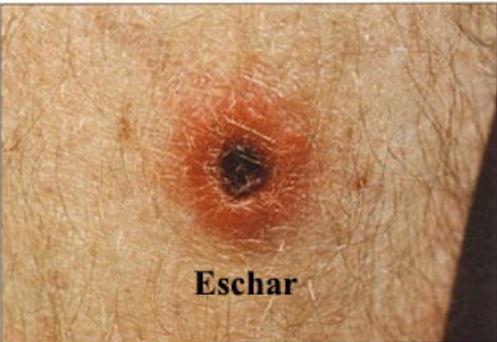
- At onset of fever, an eschar often develops at the site of the chigger bite. The typical lesion of scrub typhus begins as a red, indurated lesion about 1 cm in diameter; it eventually vesiculates, ruptures, and becomes covered with a black scab.
- Fever rises during the 1st week, often to 40 to 40.5° C.
- Headache is severe and common, as is conjunctival injection
- At onset of fever, an eschar often develops at the site of the chigger bite. The typical lesion of scrub typhus begins as a red, indurated lesion about 1 cm in diameter; it eventually vesiculates, ruptures, and becomes covered with a black scab.
- A macular rash develops on the trunk during the 5th to 8th day of fever, often extending to the arms and legs. It may disappear rapidly or become maculopapular and intensely colored.
- Cough is present during the 1st week of fever, and pneumonitis may develop during the 2nd week.
- In severe cases, pulse rate increases; blood pressure drops; and delirium, stupor, and muscular twitching develop.
- Splenomegaly may be present, and interstitial myocarditis is more common than in other rickettsial diseases.
- In untreated patients, high fever may persist ≥ 2 weeks, then falls gradually over several days. With therapy, defervescence usually begins within 36 hours. Recovery is prompt and uneventful.
Pathophysiology :
- Caused by Orientia tsutsugamushi which is transmitted by bites from chiggers.
- Orientia tsutsugamushi is a relative of Ricketsia species and belongs to the family Rickettsiaceae
Diagnostic Testing:
- Diagnosis is primarily established on the basis of clinical features, and treatment should be initiated empirically. Laboratory testing can later confirm diagnosis:
- Biopsy of rash with fluorescent antibody staining to detect organisms
- Acute and convalescent serologic testing (serologic testing not useful acutely)
- Polymerase chain reaction (PCR)
Treatment :
- Primary treatment of scrub typhus is doxycycline 200mg PO x1 followed by 100 mg twice a day in adults until the patient improves, has been afebrile for 48 hours, and has received treatment for at least 3-7 days (guidelines vary).
Prognosis:
References:
Created at: periodic/daily/August/2023-08-02-Wednesday