Typhoid Fever
Not to be confused with Typhus Fevers
Presentation :
- Associated with travel to South, East, and Southeast Asia (Indian subcontinent) and portions of sub-Saharan Africa.
- 1-2 week incubation period followed by gradual onset of fever, headache, arthralgia, myalgia, pharyngitis, anorexia, and constipation (which may later become diarrhea).
- One fifth of patients have constipation at diagnosis
- Late in the disease, when intestinal lesions are most prominent, florid diarrhea may occur, and the stool may contain blood (occult in 20% of patients, gross in 10%). In about 2% of patients, severe bleeding occurs during the 3rd week, with a case fatality rate of about 25%.
- An acute abdomen and leukocytosis during the 3rd week may suggest intestinal perforation, which usually involves the distal ileum and occurs in 1 to 2% of patients.
- In untreated illness, temperature progressively increases and may remain elevated (up to 40 °C / 104 °F) for 4 to 8 weeks. A pulse-temperature dissociation (relative bradycardia despite fever) and prostration is common.
- About 10-20% of patients develop discrete, blanching, 1- to 4-mm salmon-colored macules (rose spots) on the chest and abdomen during the second week of illness
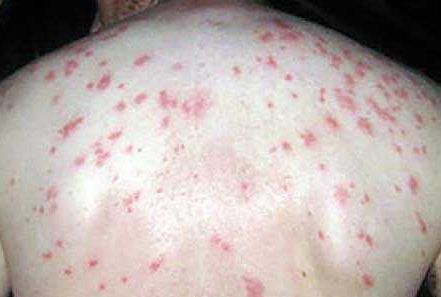
- Moderate hepatosplenomegaly, leukopenia, anemia, thrombocytopenia, and elevated aminotransferase levels are common.
- Secondary bacteremia may cause complications such as empyema, muscle abscess, and endovascular infections. Intestinal hemorrhage or perforation may occur 2 to 3 weeks after infection onset.
- Encephalopathy occurs in more severe cases.
Pathophysiology :
- Caused by Salmonella enterica serotype Typhi and Salmonella enterica serotype Paratyphi (A, B, and C)
- Acquired by consuming food or water contaminated by organisms shed in the stool of infected humans
- Gallbladder invasion by typhoid bacilli may result in a carrier state with organisms being shed in the stool for more than 1 year. Those with gallstones and chronic biliary disease are at greatest risk.
Diagnostic Testing:
- Cultures of blood, stool, and urine should be obtained.
- Blood cultures are usually positive only during the first 2 weeks of illness, but stool cultures are usually positive during the 3rd to 5th weeks. If these cultures are negative and typhoid fever is strongly suspected, culture from a bone marrow biopsy specimen may reveal the organism.
- Because drug resistance is common, standard susceptibility testing is essential
Treatment :
- Vaccination can be used for prophylaxis for travelers at high risk, providing temporary immunity in 50% to 80% of recipients
- Ceftriaxone or fluoroquinolones (for 14 days) or azithromycin (1 g day 1, then 500 mg/day for 6 days) are preferred treatments.
- Dexamethasone decreases mortality in severe illness, such as associated shock and encephalopathy.
- 4-6 week course of ciprofloxacin (Bactrim/Amox 2nd line) effectively eradicates chronic carriage, although cholecystectomy may be needed in cases of cholelithiasis.
Prognosis:
- Without antibiotics, the case fatality rate is about 12%. With prompt therapy, the case fatality rate is 1%. Most deaths occur in malnourished people, infants, and older people.
- Stupor, coma, or shock reflects severe disease and a poor prognosis.
References:
Created at: periodic/daily/August/2023-08-02-Wednesday